


What I Learned Creating a New Brand
In 2013, I was part of the leadership team at a sock manufacturer in North Carolina that developed and launched a new sock brand – Farm to Feet.
7 Lessons in Launching an Outdoor Brand

Farm to Feet socks on Appalachian Trail sign in Damascus, VA
In 2013, I helped lead the efforts to develop and launch Farm to Feet. It was a risky endeavor for the very saturated outdoor sock category, but one that our North Carolina sock manufacturing leadership team felt we could undertake. It did not surprise us, though, when we received skepticism from the industry media during the Outdoor Retailer trade show in January 2013, "Oh no, not another sock brand." But as they discovered more about the brand, they admired the concept and how we planned to differentiate it from other established industry brands. With a unique selling proposition — “100% American" — Farm to Feet stood apart from the existing competition because no other brand could make the same claim. Encouraged by the favorable reception during Outdoor Retailer, we moved forward with bringing the Farm to Feet to life. The consumer launch followed eight months later in the fall of 2013 with the first shipment of socks to retailers.
Looking back, I learned several lessons that I believe are necessary for new brands to be successful. These lessons ranged from the actions we did well, and I would not change to the steps we could have done better. For many marketers, these lessons may be obvious, but I would argue they can easily be overlooked — especially for a company that lacks marketing expertise. Regardless of one’s level of brand experience, it can be helpful to reinforce these ideas, so here are the seven things I learned while I directed the marketing for Farm to Feet Socks.
You can create a new brand in a crowded category

Farm to Feet Cascade Locks Technical Hiking Sock
We were sock knitting experts and were considered one of the best manufacturers in the industry. If we could make socks for other brands, why couldn't we create a brand that we could call ours? Cabot Hosiery had done it with Darn Tough. WigWam was a manufacturer and a brand that was nearly a century old as was Fox River. We discovered, however, that no existing brand of socks could claim itself to be 100% American made. This fact was our opportunity to differentiate and create something new in a crowded field of existing brands. What started with a few naysayers lamenting another sock brand, resulted in an exciting opportunity. We learned that yes, even though we were making socks, we could create a new brand that could differentiate itself from the competition. Farm to Feet's 100% American made socks allowed us to be unique within the industry.
Never underestimate the power of Public Relations
As we prepared to launch Farm to Feet, we selected Pale Morning Media — a Vermont-based public relations firm — to be our PR team. Leveraging their expertise with the outdoor industry media, Farm to Feet developed a comprehensive public relations and communication strategy. This plan maximized our promotional reach at a minimal cost. We initially started with trade media that targeted specialty outdoor stores. Through editorial content, we received free publicity, which in turn allowed potential retailers to easily discover us. The real impact was with consumer media outreach. As discussed in the next lesson, Parade Magazine featured Farm to Feet in an article, which resulted in an immediate surge of consumer interest upon launch. Within the first year of the brand, major publications such as Backpacker and Outside featured our socks in their gear guides — further strengthening the brand's reputation and increasing sales. Articles in the Wall Street Journal and Field and Stream resulted in significant online sales for the brand in the weeks that followed publication. Proactive public relations promoted the brand's story much faster and more efficiently than executing a paid advertising campaign with a lower cost per potential customer reached.
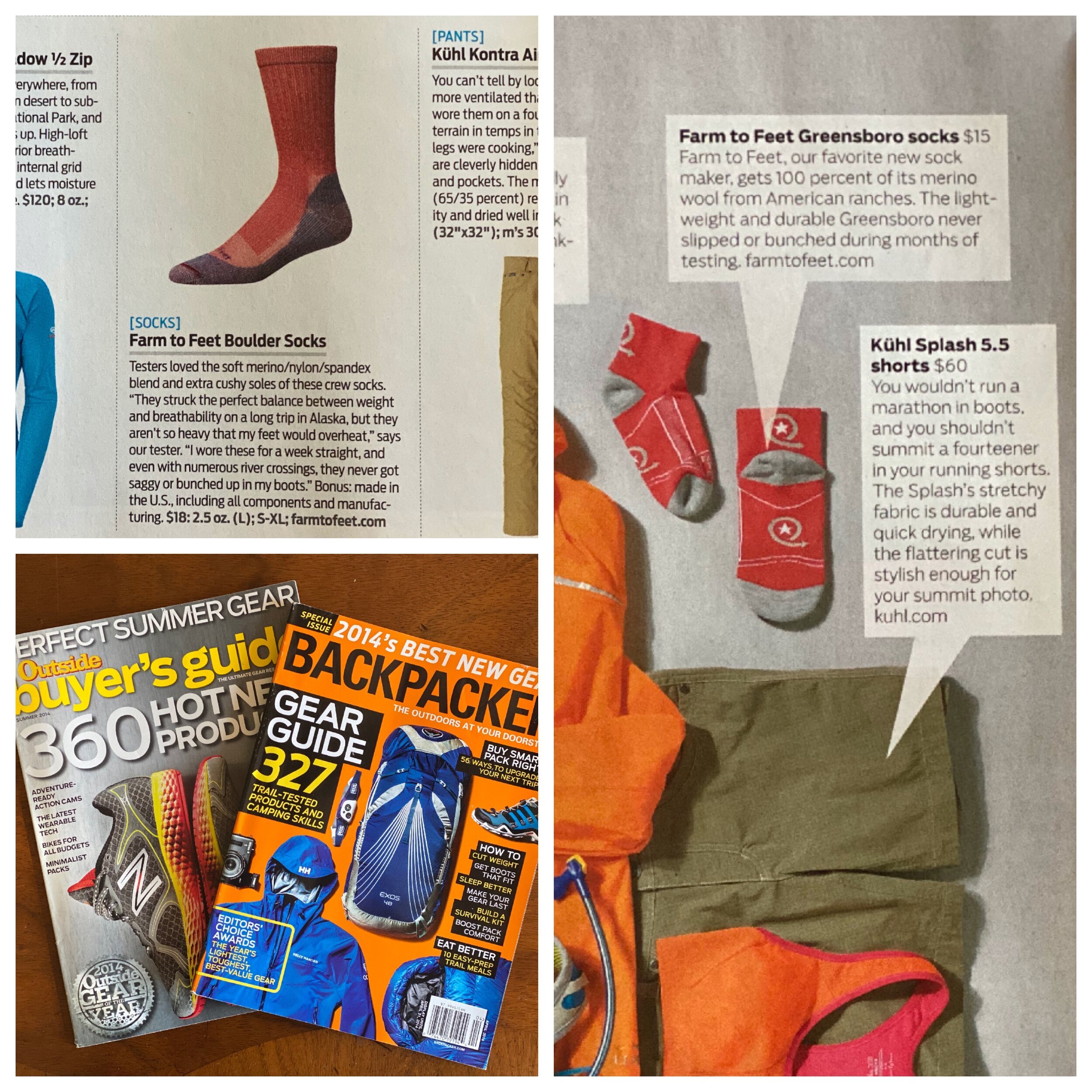
Farm to Feet socks featured in both Backpacker & Outside Summer 2014 Gear Guides
Align your distribution strategy with your marketing communications strategy
Initially, we wanted to focus on selling through independent outdoor specialty retail stores, supporting their operations by not competing with them online. We quickly discovered that this was myopic – especially for a new consumer product brand. Unless a brand has mass distribution channels and an established retailer base, your ability to reach customers is limited to only the stores willing to sell your product. Additionally, our public relations efforts started targeting consumers. Upon launch, Parade magazine featured Farm to Feet in a Made in USA article, resulting in eager sock buyers seeking Farm to Feet socks for purchase. Yet, when they searched for an authorized dealer on our website, there found none near them. Undeterred, these excited new customers then sought to purchase online, but could not. Within a week after that article and also receiving numerous requests to buy online, we created and launched an eCommerce site. In hindsight, if we were promoting nationally, then consumers needed access to the product for purchase. The easiest and quickest way to accomplish that is by including eCommerce as part of an omnichannel distribution strategy.
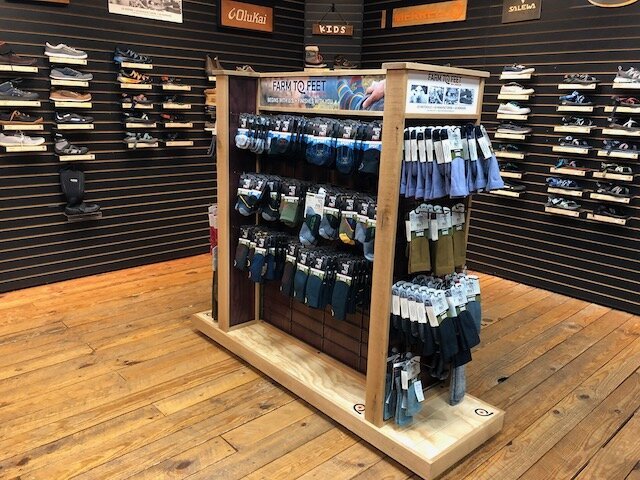
Farm to Feet display in Great Outdoor Provisions Company
Stay Focussed on Your Niche
Farm to Feet wanted to be an outdoor sock brand. Yet, we found ourselves developing socks for many different activities and uses. There is a logical reason for offering an extensive product assortment to consumers. What we learned, however, is that although some categories made sense, it quickly became quite challenging to focus our marketing resources. Moreover, our SKU and inventory management became unwieldy and financially untenable. We needed to adjust our efforts with a specific brand and product focus. This new adjustment began in 2017 as part of a branding update exercise. With outdoors as our primary focus, Farm to Feet created a new brand mission with an emphasis on trail-related activities. Ultimately the brand became re-energized with a new cynosure, allowing for the marketing team to prioritize its promotional efforts.
Brand Mission, Vision, and Values are Essential
We started with a "mission-like" statement that, in retrospect, was too broad. The brand needed clarity and a core purpose for existing. In early, 2018, Farm to Feet launched its new Mission and Vision rooted in the following principles:
Manufacture the best American-made socks
Improve the outdoor recreation experience
Advocate for the protection of wild places
Establishing a brand mission, vision, and values determine the north star for a brand – providing the essential focal point when making product and branding decisions. In doing this, we reflected our outdoor brand values, aligned Farm to Feet's purpose as a trail brand, and committed ourselves to the products we wanted to sell.

Farm to Feet’s Mission: Celebrating the American manufacturing tradition, Farm to Feet creates the world’s best socks for everyone to follow their own trail.
Be Authentic
Authenticity is a critical factor in the long-term success of a brand. We knew this when we started Farm to Feet. To begin our efforts, we ensured our marketing communications always emphasized our brand story, which included our supply chain. In particular, we highlighted the following taglines:
US Materials
US Manufacturing
US Workers
We brought this to life by sharing the stories from our supply chain and introducing consumers to real people and the companies engaged in the Farm to Feet story. We highlighted real Americans on our website and our packaging, such as Wyoming sheep rancher, Fred Roberts, to master knitting technician, Ken Shumate. Eventually, we produced a series of videos about our suppliers and their employees.
Another way we maintain genuineness was by promoting the brand story without co-opting the United States flag to demonstrate our "Made in the USA” credentials. In fact, including the national flag on our packaging was something I strongly opposed because it violated the US Flag Code. What's more, including old glory on packaging is not authentic. Real authenticity comes from storytelling, transparency, and commitment to purpose – not from placing a symbol on your packaging. Brands that demonstrate authenticity do so by providing consumers a glimpse into what makes them genuine while avoiding gimmicks that merely embellish.

Examples of Farm to Feet’s original packaging featuring people associated with the Brand

One of Farm to Feet’s marketing strategies was to partner with organizations like the Friends of the Mountains-to-Sea Trail in North Carolina
Be Marketing Centric – Not Sales Centric
A primary challenge for a private label manufacturer that becomes a consumer brand is shifting from a sales-centric mindset to one that is marketing focussed. This shift can be especially tricky when the manufacturing company never employed traditional marketing in its business strategy. Launching a brand was our company’s first foray into consumer marketing. Before creating Farm to Feet, we manufactured socks for other companies. Consequently, we did not need to promote these products to consumers, because our customers oversaw the marketing necessary to sell to the end-user. At the same time, we never relied on B2B marketing or had a marketing department. Instead, we focussed on leveraging our well-established reputation as a private label sock knitting mill to attract customers and generate sales. Yet with Farm to Feet, not only did we need to promote the brand to retailers, but we also had to generate consumer demand and interest in our socks. This effort would required marketing with sales as a critical element in the promotional action plan.
I discovered that it is difficult for those with a sales-centric philosophy to recognize that the sales team is part of the marketing mix – not separate from it. Sales professionals may disagree, perhaps seeing themselves as the primary contributor to the success or the failure of a brand. To be sure, they are essential in getting products on the shelves and in front of the consumers. Consider, however, that the marketing mix consists of product, price, place, and promotion. In that paradigm, the sales team becomes a significant element of the promotion plan. Brands need to recognize this distinction and ensure the sales team is as proficient in marketing the brand as well as they are in selling the product and generating orders. They need to be a walking and breathing promotion for the brand. This approach places marketing at the center of the sales team's actions, with sales being the metric that measures success. With marketing at the center of a brand's strategy, the sales team becomes a vital extension of the marketing promotional action plan vice marketing serving only as a support function to sales.
Creating a new brand can be exciting while also be daunting. Companies will endure adversity along the way, with the successful ones learning from the experience. Farm to Feet is still a nascent brand within the outdoor specialty retail market. Yet despite the odds, it realized success in the face of profoundly entrenched competition. During my tenure as VP of Marketing between 2013 and 2018, Farm to Feet experienced an average year-over-year sales growth of greater than 60% and increased the number of retail doors from 40 to over 1000. By 2018, our brand had become one of the better-known sock brands in the outdoor market. Although our largest competitors like Smartwool and Darn Tough enjoyed close to 70% combined market share, some retailers reported to us that Farm to Feet was 40% of their annual sock sales. By 2018, we had about a 5% market share for hiking socks in the outdoor specialty retail sales channel, compared to some well-established brands that had been around for decades earning less than a 2% share.
The secret of a brand’s success is a direct result of overcoming challenges and gaining insight along the way. Looking back, lessons that Farm to Feet learned can be illustrative for other companies wanting to start a brand. This insight included that creating a new brand can occur in a crowded product category and that public relations are essential to raising awareness upon launch — as long as you align the distribution strategy with it. Eventually, once you started a brand, its success requires a marketing-centric approach with an authentic commitment to the brand’s niche; guided by a clear mission and vision.

Author hiking with friends in Montana — wearing Farm to Feet socks

Why native content marketing can help tell your story
The current marketing landscape has produced many challenges and opportunities. Within brand and product promotion, the one main problem is the diminishing effectiveness of traditional advertising. One tool that many brands are successfully using in today's content-rich marketing environment is authentic storytelling…
The current marketing landscape has produced many challenges and opportunities. Within brand and product promotion, the one main problem is the diminishing effectiveness of traditional advertising. In today's content-rich marketing environment, marketers have multiple options ways to reach consumers. One tool that many brands are successfully using is authentic storytelling to share their messaging and engage their customers. Smaller brands, however, may find it difficult to employ this method effectively. In many cases, they are limited to both create and distribute their stories due to lack of resources. In these situations, they should consider employing native content with media outlets.
“As far as I can tell, the definitions and variables are too ambiguous to form a definitive conclusion about the death of advertising, or even what would constitute such a death to begin with. I do know, however, that traditional ad spending and effectiveness are on a seemingly endless downward trajectory. Instead of traditional ads dying, I think traditional ads are evolving—and just like slowly and gradually, dinosaur-species species evolved into bird-like species, traditional ads will evolve into some new hybrid, or new context, rather than disappearing overnight.”
Diminishing Returns of Traditional Advertisements
Consumers have become immune to traditional forms of advertising - especially among younger consumers. A recent study by the American Marketing Association (AMA) acknowledges the shifting landscape in marketing media but argues that these common forms of promotion are still useful. Jayson DeMers, however, challenges this in Forbes by stating that “traditional ad spending and effectiveness are on a seemingly endless downward trajectory.” Generally speaking, regular ads lack sufficient details, often can contain puffery and are quickly forgotten. Despite this, many companies purchase advertisements in magazines and online. In the AMA study, the author concludes “that traditional advertising has an indirect impact on new customer acquisition and brand preference.” This conclusion suggests that there is still a significant ROI with paid ads. Nevertheless, the shifting landscape may have created a point of diminishing returns. The reality is that it is difficult, if not impossible, to track ROI for print advertisements. Although metrics for online advertisements are more accessible and provide real-time information, the ads themselves are becoming increasingly less effective. Online banner and pop-up ads are a clear example of this. With the power of the internet, consumers are researching brands and products – seeking the necessary and relevant information to make a purchasing decision. Brands need to be able to provide that in a way that is accessible, valuable, and memorable.

© Liligraphie | Dreamstime.com
Traditional advertising is becoming more and more antiquated as marketers find more creative ways to engage their customers.

© Edgars Sermulis | Dreamstime.com

Example of Native Content article on SNEWS
(Click on image to read story)
Power of Authentic Storytelling
Brands that master authentic storytelling are better positioned to meet consumer need. Authentic storytelling is a way to share the value proposition of a brand with its customers while educating about its products. Some examples of stories to share are:
Product design and manufacturing - where and how
People behind the products - your employees
Consumers using the products - highlighting how the product performs
The supply chain - showing the steps and the process towards a finished product
Community engagement - how does the brand support or help others
Social Causes - what causes does the brand champion
The format of storytelling can vary including but not limited to blogs, images, and video. The easiest way to share these stories can be via the company’s website or through social media. The GLP Films website has many great examples of authentic storytelling like the “Give & Take” video series they produced for Lifestraw.
Many brands, however, are limited in reaching broad audiences beyond their current customers. Unless a brand has one million followers on Facebook or hundreds of thousands of email newsletter recipients who can amplify their message, it can be tough to reach new customers. Native Content offers a solution to brands looking to reach large audiences with their content.
Native Content Solution
Traditional as well as online media companies are realizing the challenge discussed above. Although media companies may still offer conventional forms of advertising, they are expanding their value proposition to brands. By leveraging internal creative resources, media outlets can help brands with both content creation and message amplification through many channels. Brands using native content can reach the same target audience as traditional advertisement with more meaningful and memorable content. Brands pay for this content to be created and published, but it is not merely “Pay for Play.”
Example of Native Content & Authentic Storytelling
An illustration of the effective use of native content occurred when I was VP of Marketing for Farm to Feet socks. Partnering with the American Wool Council, Farm to Feet leveraged the creative team at SNEWS to create native content that focused on the wool supply chain in the United States. As a result, we were able to develop several well-written articles that discussed various aspects of the wool industry in America and the critical role it plays in performance apparel. Although the column displayed the label “Sponsored Story” it was not merely a pitch focused on Farm to Feet. An added benefit with this approach is that because the content is online, it can be leveraged for sharing in the future when necessary with no additional costs.
An example of authentic storytelling by the brand Lifestraw - this is one of four videos produced by GLP Films, which follows the adventurer and philanthropist Bill Yeo, who exemplifies the spirit of exploration, mindful living, and giving back to the community.
conclusion
Brands face many challenges in promoting products. A significant problem in today’s web-based economy is that traditional advertising is becoming less effective – especially when consumers are looking beyond advertising and conducting their own research. Brands can combat this by investing in authentic storytelling that shares not only the brand’s unique value proposition but also relevant product information. Amplifying the message in these stories can be accomplished by working with media outlets to create native content instead of conventional ads. Native content is a novel way to provide both new value beyond paid advertisements and evergreen content when applicable. By working creatively with media professionals, marketing teams can pursue brand and product awareness and promotion with an innovative approach that tells their story and educates customers about their brand and products.