


Sustainable Brands Should Not Use Cost to Set Pricing
Companies deciding to venture towards a more eco-friendly model need to view the added cost of doing so not as an expense, but as added value — then communicate that to their customers. The marketing team makes that happen. By first incorporating the customer’s sustainability requirements into the product offerings, marketing then translates that added value into a monetary value the customer assigns to it, conveying it to them with a price they are willing to pay. Ultimately, their goal is to ensure that the price is neither too high nor too low.
Viewing Sustainability as Added Value
The Top Barriers to Buying Sustainable Brands
Price premium: Globally, consumers cite price premium as a leading barrier to buying sustainable products.
Lack of awareness and trust, and confusion about sustainability claims: Lack of awareness, as well as trust issues and confusion about claims, are also top deterrents.
Source: The Conference Board - Global Survey Asks 30,000+ Consumers About Views on Sustainability (Feb 2020)
According to a survey of consumer views on sustainability by the Conference Board, two factors hinder the purchasing of sustainable products: the price premium and lack of consumer awareness. This is probably not surprising to companies producing more sustainable products. At the same time, "NYU Stern’s Center for Sustainable Business performed a study in which they discovered that 50% of CPG growth from 2013 to 2018 came from sustainability-marketed products. This suggests that many customers are moving away from less eco-friendly products and “voting with their dollars — against unsustainable brands.” (Source: Research: Actually, Consumers Do Buy Sustainable Products).
What does this mean for companies pursuing a more sustainable business model?
First, existing brands should realize their customers need to understand the value being offered — is the price they are paying worth it? Therefore, pricing should be based on the brand or product’s value proposition - not cost.
“For a company like ours, pricing is largely driven by cost structure.”
There is no doubt that companies employing sustainability practices may realize higher costs due to their efforts. Sustainable packaging company — EcoEnclose — provides an interesting example of sustainability and pricing in which they explicitly state that cost structure drives their pricing.
Yet, further reading on that page reveals that the real basis for their pricing strategy is the value chain they provide their customers. As their website states: “EcoEnclose has made informed decisions we believe are essential to living out our commitment to sustainability and offering our customers value and transparency in the form of true eco-friendly packaging.” Specifically, they offer the following seven unique selling points:
They offer “Source Verified and Consistent Recycled Content.”
They have mastered the “Impact of Manufacturing with Recycled Content.”
“Where Items Are Manufactured” is in the United States.
Their “Size of Business and the Type of Operations” — independent nature and smaller size directly translate into increased customer service commitment.
They provide leadership on sustainable “Innovation and R&D”
Their products offer many “Features and Functionality”
“Your Brand and the Customer Experience” benefits from their packaging options serving as the first tangible impression a company will make on their customers.
Therefore, instead of treating these expenses as costs, they should view them as added value for their clients. Rather than explicitly stating why their prices are higher, they could emphasize their unique selling point derived from their sustainability choices. (which, perhaps is the intent of the page)
A simple syntax change – replacing “cost structure” with “value chain” could change EcoEnclose’s discussion.

EcoEnclose is a leading sustainable packaging supplier

Aligning pricing strategy with the unique value proposition of sustainability can help encourage customers into paying more for sustainable products.
Companies deciding to venture towards a more eco-friendly model need to view the added cost of doing so not as an expense but as added value — then communicate that to their customers. The marketing team makes that happen. By first incorporating the customer’s sustainability requirements into the product offerings, marketing then translates that added value into a monetary value the customer assigns to it, conveying it to them with a price they are willing to pay. Ultimately, their goal is to ensure that the price is neither too high nor too low.
Other topics in marketing and sustainability

Will 2021 See a Return to "Normal"
As the new year begins, many may wonder if life will return to normal. This is reasonable. Vaccines for COVID-19 are beginning to be distributed and new leadership in Washington DC is about to begin. Yet, a recent article in Marketing Insider by Molly Lewis suggests that “There Will Be No Return To Normal”.
As the new year begins, many may wonder if life will return to normal. This is reasonable. Vaccines for COVID-19 are beginning to be distributed and new leadership in Washington DC is about to begin. Yet, a recent article in Marketing Insider by Molly Lewis suggests that “There Will Be No Return To Normal”. She opines that despite everyone’s desire for normalcy again, many simply do not “comprehend the implications of the pandemic’s deep and lasting impact on the human condition as we know it.” And there is data to support Molly’s observation.
As the article discusses, in a study, “The Human Condition 2020: Shock to the System,” surveying Americans on their views in face of a pandemic, a vast majority (87%) do not believe we will return to normal highlighting issues such as stagnating careers. Moreover, these concerns will have an impact on how marketers base their assumptions for strategic planning moving forward.
Molly does offer an encouraging perspective. Many respondents in the survey indicated they were making positive lifestyle changes. This outlook can provide marketers with fresh insights on how to develop their marking mix in the post-pandemic marketplace. As she concludes:
“For marketers struggling to understand their consumers today, these findings are critical. Truly understanding the varied experiences people are having — particularly as it relates to our relationships, our sense of place, and our personal purpose — is vital to creating meaningful and compassionate action with brands, employees, and individuals.”
With the new year in its early days, COVID-19 vaccinations underway, and hope for post-pandemic life, marketers need to evaluate their marketing plans NOW. The pandemic has resulted in changes in consumer behavior and attitudes.
Are your company and brand prepared for what comes next?

The source for this post was from Molly Lewis’s Marketing Insider article: “There Will Be No Return To 'Normal'“

Brands Don’t Need to Use the U.S. Flag to Promote “Made in the USA”
When I was Vice President of Marketing at Farm to Feet, one of our sales representatives asked on behalf of a retailer the question, “why we did not include an American flag on any of our marketing or our packaging.” …. I responded by telling the sales representative that the United States flag code prohibits the use of the American flag for marketing and advertising purposes. Quite simply, I said, “using the U.S. Flag for marketing is disrespectful.”
Your story is a more compelling symbol for “American-Made.”

“The flag represents a living country and is itself considered a living thing.”
When I was Vice President of Marketing at Farm to Feet, one of our sales representatives asked on behalf of a retailer the question, “why we did not include an American flag on any of our marketing or our packaging.” The retailer felt that since the brand was marketing itself as 100% American, then we should include the flag on the packaging and in our promotional materials. I responded by telling the sales representative that the United States flag code prohibits the use of the American flag for marketing and advertising purposes. Quite simply, I said, “using the U.S. Flag for marketing is disrespectful.” Adding credibility to my perspective was that I was a retired Navy Officer with 22 years of service. After explaining my position on the issue and providing him with the appropriate references, he agreed with my opinion and proceeded to share it with the retailer who inquired. Though I am generally not offended by the use of the flag in marketing, I do believe many companies and brands needlessly use it and that some businesses push the boundaries of disrespect in their use of it for the sole purpose to generate revenue.
Is it really wrong
A valid question to ask is whether using the U.S. Flag for marketing purposes inappropriate or not. One way to answer this is to evaluate Title 4, Chapter 1 of the United States Code. This statute is the section of federal law that applies to the United States Flag. In particular, Section 8 – Respect for the Flag – outlines what is considered respectful and disrespectful in the use and display of the national ensign. Paragraph 8.i specifically calls out prohibition in marketing.
“The flag should never be used for advertising purposes in any manner whatsoever. It should not be embroidered on such articles as cushions or handkerchiefs and the like, printed or otherwise impressed on paper napkins or boxes or anything that is designed for temporary use and discard. Advertising signs should not be fastened to a staff or halyard from which the flag is flown.”
A literal reading of the first sentence seems to be pretty clear: “The flag should never be used for advertising purposes in any manner whatsoever.” Still, businesses do it. Moreover, variations of “Made in USA” labels use the American flag on product packaging and promotional material. Therefore, the valid second question is, “why do companies seem to violate the code flagrantly?” The simple answer is “because they can.” Title 4 has no punitive actions for violating the flag statute, such as fines or imprisonment. The law’s intent is to provide standards for respecting the national symbol.
Mostly, the code is followed – especially within the government, military, and civic organizations. The most significant violations of the statute are by those who are ignorant of its existence or are protesting against the United States. Yet, businesses that use it for both marketing and profit-making purposes are also guilty of infringing on the rules. Another argument is that the 1st amendment provides companies a constitutional right to do so as a form of speech. This opinion is both a valid and respectable one, as long as those who make it are not hypocritical in applying the freedom of speech card.
It also seems that most people are not necessarily bothered by it. In this blog by the branding agency absolute, the author shares insight into that perspective. They conducted an informal survey on Facebook and found that a plurality of respondents was indifferent, and only a fourth were offended. In one response, a veteran indicated that he had no problem with using the flag in advertising if tastefully done. That perspective, however, does leave the determination of what is “tastefully” to subjective opinion.
Regardless of whether it is right or wrong, many companies and brands still use the U.S. Flag in marketing and advertising. For example, the tool brand Channellock prominently displays a flag with the words “100% Made in the USA” on their website. Additionally, their product pages, show the stars and stripes below “Made in USA.” Channellock is a remarkable company with an impressive 130 plus year history of manufacturing in Pennsylvania. Their story alone speaks to their commitment to American-made. They should consider focusing on that and emphasize it on their home page instead of using the flag throughout their website.
Ultimately, there are three conclusions one can make on the topic of the appropriateness of using the flag in advertising and marketing:
Using the flag in advertising indeed violates the U.S. flag code
Companies continue to use the flag for promotion and marketing despite this violation because they can with no punitive action against them.
Freedom of Speech enshrined in the First Amendment of the U.S. Constitution provides a valid argument for allowing them to do so.
So, the real question to answer is, “do companies and brands that produce and sell American-made products need to use the flag in their promotions?”
The short answer to that question is “No.”
American Companies Don’t Need to Use the Flag in Marketing
A brand that manufactures its products in the United States should be proud and want to share that fact with their customers. But does that require placing the U.S. flag on product packaging or within promotional materials to convey that message? Moreover, if that is the only thing a business is doing to promote its American-made bona fides, then perhaps they need to hire a new marketing team. Relying on the words “Made in USA” with the flag on a product label may be accurate, but it lacks originality and creativity. Quite simply, it is lazy.
Consumers need more than a label with a flag to become committed to a company and its products. Today’s they want to feel connected with the brands they support, and marketing teams need to engage customers with more than just a patriotic symbol. They want to know what makes a particular company an American brand they should support. Perhaps the best way to do that is through storytelling. By telling the company story, customers can very easily and emotionally connect with the brand. What’s more, a good narrative communicates to them that this business is one that embraces “Made in the USA.”
Here are three ideas for engaging storytelling. The first two are very easy for any company to do while the last one may require additional effort. Regardless, all three are very effective ways to share pride in a brand’s “American Made” story:
Tell Your History – sharing a business’s story allows the best narrator to tell it — the company itself. There are many ways to articulate the company’s narrative from telling its origins to offering vignettes of major milestones. Still, at the very least, it should include company ownership, its location, and the timeline from founding to the present day.
Show how it is done – today, consumers want to know a company produces the items they purchase. Share the manufacturing process through a written story, still images, or video. These narratives will demonstrate both your company’s expertise and craftsmanship.
Invite people to visit – company tours can be a powerful way to share your story and make it real to your customers – solidifying your “Made in the USA” credentials with them and perhaps creating a customer for life. If you do offer company or factory tours, be sure to let your local Chamber of Commerce and Tourism Bureau know so they can help direct visitors to you and perhaps land you first-time customers who did not know you existed.
Two Examples

Jack Daniels
Take, for example, the long history of the distillery located in Lynchburg, Tennessee – Jack Daniels. Established as the very first American registered distillery in 1866, it endured two world wars and prohibition during its 150 plus years of existence. It was not until the 1960s before it went from a regionally known spirt to a nationally recognized whiskey brand. Their history is rich with heritage that includes incredible challenges typical of iconic American legends. Also, they show you how they turn the spring water of Tennessee into legendary whiskey. They walk you through the process that begins with water from the Cave Spring to the multi-year maturation process. As you finish reviewing the fine details of whiskey making, they invite you to visit them at the distillery in Lynchburg, where you can see the process personally. And yes, you are offered an opportunity to sample.

I toured their facility in November 2011 and experienced an in-depth view of the process that would transform wood I selected into my custom guitar.
Santa Cruz Guitar Company
Unlike the Jack Daniels story, which evolved with each new master distiller, the Santa Cruz Guitar Company (SCGC) history is the story of its master luthier and founder – Richard Hoover. Located in a small nondescript shop in Santa Cruz, CA, SCGC is a custom guitar manufacturer and has made guitars for nearly 45 years. While some guitar companies manufacture 400-500 guitars per day, SCGC hand makes only 400 guitars each year. Besides Richard’s story, the production process he created is what truly establishes its American craftsman credentials. SCGC’s website also provides a virtual tour of the shop with detailed videos showing the craft of guitar making. They also offer guided tours of their shop upon appointment, where they will walk you through all the stages of hand-making their premium instruments.
Your Story is a More Compelling Symbol
Companies and brands that produce their products in the United States should be proud of that. They need to leverage their unique American Made story as part of their marketing process while refraining from exploiting the country’s flag for advertising and commercial purposes. As the flag code states: “No disrespect should be shown to the flag of the United States of America.” Using the flag in marketing is a form of disrespect, and companies need to consider that and comply with the statute. Instead, employ other ways to celebrate being made in the USA. Storytelling is one of the best ways to achieve that, and many companies have rich stories to share with their customers. As Jack Daniels and the Santa Cruz Guitar Company exemplify, share your history with your customers, show them how you make the products they love, and invite them to visit your factory so they can witness firsthand how it is done. Ultimately, it is your story and your emphasis on your craft that will resonate with them and turn them into loyal followers and advocates for your business.

Patriotic Holiday Tips for Marketers
For each of America’s patriotic observations (Armed Forces Day, Memorial Day, Veterans Day, and Independence Day), brands should consider what the holiday means, recognize and focus marketing promotion on that.
It’s the time of year when the United States observes several patriotic holidays, marketers should understand what each one observes
Several years ago — during Memorial Day Weekend — a high school student who knew I was in the Navy said to me, “Happy Memorial Day — thank you for your service and sacrifice.” I thanked him for his kind words, but then I added: “But I’m not dead.” I know this shocked him as it did his parents.
I didn’t say this out of spite or to question his sincerity in what he said. What I wanted to do was share with him why we observe Memorial Day or, more importantly, who we honor — those who died in the service of their country. For me, President Truman said it best in these words that can be found in the WW II Memorial on the Mall in Washington DC.
“Our debt to the heroic men and valiant women in the service of our country can never be repaid. They have earned our undying gratitude. America will never forget their sacrifices.”

© Jixue Yang | Dreamstime.com
In our current post-Vietnam (and now post 9/11) American society, no one ever wants to be seen as unappreciative of our military. So much so, that we tend to make every symbolic American holiday a rallying cry for “Supporting our Troops.” We thank them and our veterans for their service and sometimes, like my young friend above, forget the actual meaning of the holiday. Now don’t get me wrong, I am not saying that Americans should not support our troops or that we should not show our gratitude to all veterans — by all means, we should.
What I am suggesting, however, is that as Americans, we need to acknowledge that our symbolic holidays are unique and created with a specific purpose in mind and reflect on that. This perspective is no different for companies and brands. Marketers looking to create content around these holidays need to serve as honest brokers of the messaging in patriotic holiday promotions. Inappropriate messaging is off-putting and may do more harm to a brand’s reputation than good. To assist in developing content, here is a summary of a few of America’s key patriotic holidays.
Armed Forces Day

© Joe Sohm | Dreamstime.com
On the third Saturday in May, we celebrate Armed Forces Day — a day started back in 1949 to honor all the Armed Forces. Yet unless someone lives near a military or naval base, your community probably fails to celebrate or even acknowledge it. This day celebrates and honors all those who are currently serving. Companies located near military installations could treat this holiday as an opportunity to honor their military neighbors by creating content to promote its significance. Nationally, brands could also observe this day and help raise awareness with their customers.
Memorial Day

© Lindaelizabeth | Dreamstime.com
Originally called Decoration Day, Memorial Day began after the Civil War, and communities observed it on May 30th for nearly a century. In the late 1960’s it became a federal holiday and was officially moved to the fourth Monday in May. Unfortunately, Memorial Day weekend is now considered the “official start” of Summer, with most marketing efforts focused on that theme. Brands wishing to observe the holiday as intended, need to be reverent and emphasize the ultimate sacrifice that one can give to their country. This type of content can be tricky, but if done well may offer an opportunity to engage consumers authentically.
Independence Day
Independence Day is probably the most sacred of American patriotic holidays. There is no doubt that the military is paramount to protecting our freedoms and defending our Constitution — from the days of the Continental Army & Navy to now. So, it is fitting to honor both those who are serving and have served in the Armed Forces. Nevertheless, we would be remiss if we allow Independence Day celebrations to only honor the military. Celebrating the birth of our country demands much more, we should celebrate all Americans. In addition to our armed forces, many Americans played essential roles in this ongoing experiment of democracy. Brands wishing to promote an Independence Day theme should not limit themselves to honoring just the military. Besides the military, consider how each of the following types of people has been critical to America’s success:

Independence Day celebrates all Americans (Image Source: Dreamstime.Com)
American Workers
Educators
Protestors
Business Owners
Immigrants
Civil Service
Elected Official
Faith Leaders
This view is even more true in 2020. With the COVID-19 pandemic, consider how medical professionals, first responders, grocery store employees, and sanitation professionals have also been essential to American life. Maybe this year, Independence Day could and should honor them.

© Jixue Yang | Dreamstime.com
Veterans Day
Although not celebrated until November 11th, Veterans Day is another sacred patriotic holidays. It is the day that we honor all Veterans and their service to our country. Its history dates back to WW I and the commemoration of Armistice Day — the historical end date of “the war to end all wars.” Today, many businesses offer special promotions and discounts during this holiday. There is another approach that companies might consider. Instead of focusing outward, they could look inward and identify how many of their employees are veterans and honor them — that very well may be an excellent marketing campaign too.
As we all get ready to observe Memorial Day this year, brands should take a moment to reflect on the occasion instead of promoting the start of Summer. Likewise, for each of America’s patriotic observations (Armed Forces Day, Veterans Day, and Independence Day), consider what the holiday means, recognize and focus marketing promotion on that.
Author’s note: I served in the United States Navy for 22 years, retiring in 2009.

Manufacturers Need Marketing to Become a Brand
Today, contract manufacturers are starting to create consumer brands of their own. This idea is attractive, especially when you consider the potential profit margins. Many manufacturers, however, are not structured for creating a brand. The biggest challenge these companies face is a lack of a marketing-centric outlook due to adhering to a superannuated sales-centric mentality.

© Convisum | Dreamstime.com
Manufacturers that want to create a brand need to be “Marketing-Centric”
“Marketing is as different from selling as chemistry is from alchemy, astronomy is from astrology, chess from checkers.”
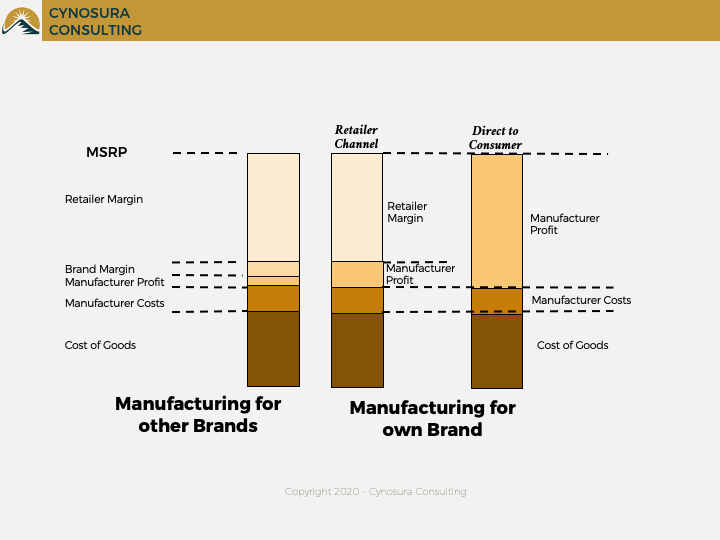
Contract manufacturers that create their own brand can increase the potential for larger profit margins on products sold.
Most brands do not manufacture the products they sell in the marketplace. In most cases, the branded company does not own any manufacturing facilities and instead purchases their finished goods from a manufacturing supplier through what is typically called Contract Manufacturing. This reality is especially evident in consumer products such as electronics and apparel. For example, a separate company called Hon Hai Precision Industry Co., LTD (more commonly known as Foxconn), produces Apple's iPhone. Interestingly, this company also makes smartphones for Apple's competitors as well, which is not uncommon for many contract manufacturers. The fact is that many contract manufacturers are behind the scenes. In several cases, they are also responsible for the innovations that many brands tout as their own. I, too, worked for a contract manufacturer in the outdoor industry. Recognized as a leading innovator in hosiery manufacturing, we made products for many established brands as well as numerous private label retailers.
Today, contract manufacturers are starting to create consumer brands of their own. For example, Foxconn created a brand of smartphones. This idea is attractive, especially when you consider the potential profit margins. A manufacturer can realize a healthy gross margin on its own branded products compared to ones it manufactures for other brands. Many manufacturers, however, are not structured for creating a brand. The biggest challenge these companies face is a lack of a marketing-centric outlook due to adhering to a superannuated sales-centric mentality.
In my experience, profitable and growing contract manufacturers were successful by focusing on two critical tenets: 1) Quality Products and 2) Competitive Prices. This emphasis made sense. Their customers – Brands – were concerned about the same thing. The main difference is the role marketing plays in the relationship between manufacturer and brand compared to that of brand and consumer. It’s this difference that eludes manufacturers who wish to become a consumer brand. In their current customer relationship paradigm, a sales-centric strategy worked with marketing only seen as a support function to the sales organization.
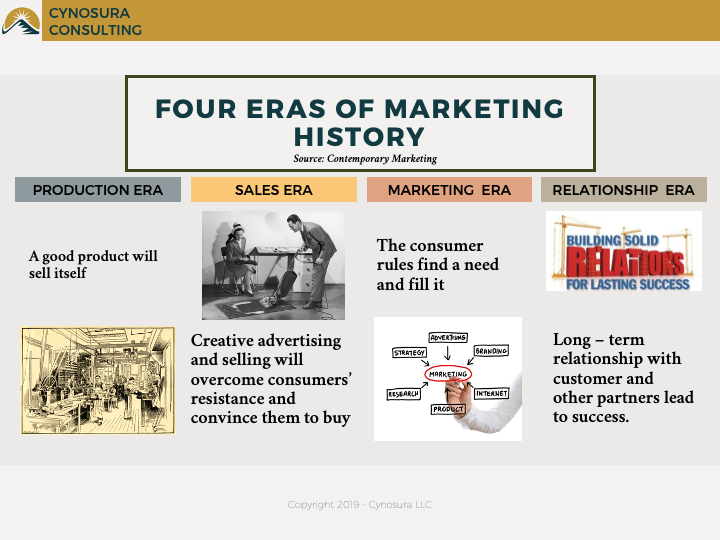
David Kurtz’s four eras of marketing history from “Contemporary Marketing.”
This perspective has its roots in what author David Kurtz refers to as the “Sales Era.” In the book “Contemporary Marketing,” Kurtz discusses the four eras of marketing history. His evaluation identifies the “Sales Era” as a shift in the business/customer dynamics that occurred in the early 20th century as manufacturing output increased. Companies began to shift their focus on growing a sales force to find and retain customers. According to Kurtz, “Companies with a sales orientation assume that customers will resist purchasing nonessential goods and services and that the task of personal selling and advertising is to persuade them to buy. Kurtz further notes that “although marketing departments began to emerge, they tended to remain subordinate” to sales. The discussion of marketing history notes, however, that this era seemed to have faded in the middle of the last century – giving way to the Marketing Era and the Relationship Era. Yet today, many manufacturers still seem to remain in the Sales Era – perhaps because it works for them or maybe because they don’t know any different. Their reluctance to shift to marketing-centric orientation will hinder their ability to create and grow a brand. As Theodore Levitt said in “Marketing Myopia,” “The difference between marketing and selling is more than semantic. Selling focuses on the needs of the seller; marketing on the needs of the buyer.” Marketing emphasizes fulfilling consumer needs. Branding is one of the most powerful tools that can influence a customer’s product perceptions. Stated, you cannot become a brand without marketing. It is not a smooth transition from actively selling your products and manufacturing capability to the effort of marketing a brand to consumers. The same techniques used to achieve sales success previously will no longer work.
“Selling focuses on the needs of the seller; marketing on the needs of the buyer.”
So how does a manufacturer overcome its "Sales Era" paradigm to become a brand?
The most crucial step is to enter the 21st century and embrace the tenets of what Kurtz calls the "Relationship Era." This transformation involves developing long-term relationships with the entire value chain from suppliers to customers and other strategic partners. Coupled with this shift is recognizing the importance of marketing to building and sustaining these relationships. The marketing team can no longer be subordinate to sales. They need to be leading the brand's development efforts to include everything from branding to directing the marketing mix. Still, it's essential to recognize that the sales team's function doesn't change in this new orientation. Depending on the sales channels, a sales force will now need to promote and sell the branded product to retailers or distributors. Yet now, they are acting as part of the marketing mix – one of several effective promotion methods necessary to build brand awareness and growth. Although they are still selling a product, they are now also responsible for developing new relationships by promoting a brand.
Consider the contract manufacturer – Cabot Hosiery, located in Vermont. A multi-generational hosiery mill that began making socks in 1978 for apparel brands. But in the early 2000s, after many customers ended contracts with Cabot, the owners had to make a decision. They either had to close the mill or change their business model. The owner's son, Ric Cabot, proposed creating a brand. Instead of manufacturing for other companies, Cabot Hosiery became "Darn Tough." Instead of earning minimal profits from contracts, Darn Tough saw an opportunity to gain a significant gross margin by selling its socks at a premium price within a niche market. Their future success was rooted in their commitment to using marketing to develop and grow the brand, starting with the effective use of promotion to introduce the brand in 2004 when they gave away 3500 pairs of socks at the Vermont City Marathon. Word quickly spread about the sock's durability and the brand's game-changing value proposition of a "Lifetime Guarantee." By the 2010s, their distribution was nationwide, and the brand saw a 60% growth in annual sales. Today, they are a leading outdoor sock brand – second only to Smartwool according to most industry reports.

From Darn Tough Website
Companies that remain in the "Sales Era" are no longer relevant in today's "Relationship Era." They have to evolve. No longer can companies allow marketing to be subordinate to sales. A manufacturer that wants to create and grow a successful brand must be committed to establishing a marketing-centric organization. On the other hand, if a business chooses to retain its sales mentality, they may see short-term revenue, but they will fail to realize long-term brand growth.

Branding and the Marketing Mix
Most companies understand how promotion and branding are related, but what about the other 3 P’s in the Marketing Mix?
Most companies understand how promotion and branding are related, but what about the other 3 P’s in the Marketing Mix?

ID 139076061 © Opolja | Dreamstime.com
Anyone that has ever taken a marketing class will remember learning the marketing four P's, Product, Price, Place, and Promotion. These four pillars of the marketing mix are the foundations for any marketing degree. They are at the root of what any marketer should consider when creating a marketing strategy.
It seems, however, that when companies get into the nuts and bolts of their marketing, many marketers lose sight of the basics. Companies perhaps too heavily focused on Promotion, lose sight, or even relinquish control of the remaining three P's to other parts of the organization. This oversight is extremely myopic for any company, but especially counterproductive when trying to build a brand.
The consumer establishes a brand’s value in the market. Consequently, a brand’s effectiveness directly determines the success of its promotional efforts. The importance of Promotion, therefore, rarely eludes most companies when it comes to brand development. What is less obvious, is the role that the other 3P's play in creating brand value. Influencing consumer brand perception relies on the strategic decisions made regarding Product, Price, and Place.
Below are three strategic insights that marketers should consider when creating a brand.
Beyond the Core Product

ID 21436808 © Win Nondakowit | Dreamstime.com
While teaching a Principles of Marketing course, I discovered fresh insight into Phillip Kotler's three levels of product. Unlike Kotler’s viewpoint, this new strategy perspective describes product offerings as follows:
Core Product: represents the solution for sale—the form/function utility that creates the set of benefits that allow it to fill a need.
Expanded Product: includes the mix of tangible attributes and intangible product support.
Product Concept: describes the product in terms of the market niche to be served, the life cycle it will experience in the marketplace, and the impact of manufacturing and selling it on the company itself.
(Source: Principles of Marketing and Personal Selling – edited by Miguel Sahagun)
Most, if not all, companies understand the core product concept. Beyond that is this idea of the expanded product: what does the product include that allows it to stand out or differentiate itself from other products in the same category? These factors could be anything that adds either tangible or intangible value, such as the type of packaging used to warranties or even just the ease of possession by the consumer (e.g., payment plans and delivery options). Again, many companies understand this aspect and apply it to their product marketing strategy. Even more broadly, however, is the product concept perspective. This strategic choice is where brands truly start to differentiate themselves in the branding process. It can be especially powerful if the brand can create a new product classification as a result - think Apple iPhone's creation of the smartphone category. Another great example is how Smartwool created the performance merino wool outdoor sock category.

By applying the Product Concept, Smartwool created a new category: Technical Performance Outdoor Socks
Image: Smartwool Socks on display at Great Outdoor Provisions Co in Winston Salem, NC (Credit: David Petri)
Smartwool started back in the early 1990s - founded by a couple of ski instructors. They wanted to make better ski and hiking socks (Core Product). To differentiate, they chose New Zealand Merino wool. Merino wool offered not only the traditional properties of wool (insulating even when wet), but unlike coarser wool, it was not itchy. Additionally, they used shrink-treated yarn, which allowed consumers to dry their socks in a dryer (Expanded Product). What ultimately set them apart was the premium price they charged. At $20/pair, Smartwool challenged the conventional wisdom at the time - the idea that consumers would not spend that much on a pair of wool socks. Indeed, the outdoor industry scoffed at this when the brand introduced itself at the Outdoor Retailer trade show in 1995. Yet after retailers discovered the value that consumers would receive with Smartwool, the brand took off. As a result, Smartwool had created a new outdoor sock category - Premium Technical Performance Socks (Product Concept). Twenty-five years later, the brand maintains a greater than 50% market share for socks in the outdoor specialty retail channel. Today, multiple premium outdoor sock brands are competing in this category, including brands like Darn Tough, Point6, Fox River, and Farm to Feet.
(Source: Company Week: Smartwool by Chris Meehan)
Make Sure the Price is Right
Perhaps the easiest way for many companies to determine price is by marking up product costs with a target profit margin. Most marketing professionals, however, will state that's not how you create a pricing strategy. A detailed discussion on pricing strategy is a separate topic itself with countless articles on pricing that demonstrate how this approach risks leaving money on the table. Marketers must recognize that Price impacts branding. As a result, they need to consider three primary issues: Reference Pricing, Strategic Objective, and Pricing Strategy.
All consumers maintain a reference price for most goods and services. This comparison typically manifests itself as a range of acceptable prices. Brands entering an existing category need to be sensitive to this and ensure that their offering falls within that range. Consumers may draw premature conclusions about the brand if the offering price is at the extremes. If too low, then quality and value may be questioned. In contrast, if too high, consumers may not even consider the offering. Perhaps the rare exception to this is if the brand can create a new category as Smartwool did with socks and Apple did with the iPhone.
Next, brands need to determine their strategic objective regarding pricing decisions. Most marketing literature details two specific pricing strategic objectives:
Profit Maximization - the aim is to generate the highest net income over time. All sales need to ensure that acceptable profit margins are maintained.
Volume Maximization - the primary objective is to generate as much sales volume (and revenue) as possible. This objective creates cash flow at the risk of lowering profits or operating at a loss.
(Source: Principles of Marketing and Personal Selling – edited by Miguel Sahagun)
Volume maximization may be appropriate for commodity offerings in which narrow profit margins are the norm for the category. Yet, I would argue that most brands are seeking long-term growth, which requires investment to increase brand awareness, market penetration, and growing brand loyalty. The best strategic pricing objective, therefore, is maximizing profits.
There are multiple pricing strategies out there. Some brands employ skim pricing, charging a high price to attract a particular consumer or to exhibit a specific value to consumers. This approach primarily works for luxury or premium brands. Other brands go with a price penetration strategy, which is employed to generate sales. In this situation, the company is more likely seeking volume maximization. A new brand looking to compete in an existing category, though, should consider neutral pricing - aligning your price with the competition. Brands using this approach are less likely to turn away potential consumers by being too expensive or leave money on the table at a lower price.

ID 117047040 © Ognyan Chobanov | Dreamstime.com
Beyond matching competitors' prices, neutral pricing requires two critical steps before implementation. The first is that the brand’s differentiation has to be crystal clear. Next, brands need to research the market and determine its positioning among the competition. These two steps, coupled with price parity, allows brands to offer a unique selling proposition to consumers. This competitive differentiation provides your potential customers with more value at the same price. Without it, consumers are less likely to consider your offering.
When I was VP of Marketing for Farm to Feet, we applied a neutral pricing strategy. Our goal was to be a premium sock brand with a 100% American made value proposition. We set our prices on par with our closest competition by evaluating brands such as Smartwool and Darn Tough. Pricing our products on par with existing premium outdoor performance wool socks allowed us to leverage the current perception of these known brands. Ultimately, Farm to Feet justified its premium pricing using the brand's competitive difference, securing its place in the category.
Place is not Just a Location

ID 90241988 © Edgars Sermulis | Dreamstime.com
Traditionally, many people think that Place, from a marketing perspective, refers to the sales channels or specific "Retailers." And for a long time, that was probably the prevailing mindset or thought. Today, however, marketing courses are teaching that Place refers to the overarching value chain. More and more, companies are including both the product's supply chain and the distribution channel in the marketing mix. Brands seeking to be more transparent with their customers recognize the value of this approach. For some companies, the product's supply chain is an essential branding attribute. Choosing the right suppliers can be as important or, in some cases, more important than the distribution channels in creating brand value. Being aware of that can improve the brand's image.

Icebreaker made supply chain part of its brand - inviting consumers to learn about the source of the Merino Wool used in its products.
Image: Merino Wool Ranch that supplies Icebreaker located on the South Island of New Zealand (Credit: David Petri)
The brand Icebreaker provides an excellent example of employing the value chain in the company's branding. Icebreaker is a Merino New Zealand based apparel brand, now owned by VF Corp. Using New Zealand Merino wool, Icebreaker created a whole line of apparel, including everything from base layers to outerwear and accessories. For several years, they included what they called a "Baacode" - a distinct number on every product package. Using this code, customers could enter the code on the brand's website, and learn about one of the Merino wool ranches in New Zealand. Currently, their website provides a robust supply chain story. This commitment to transparency results in the product supply chain becoming an essential part of the Icebreaker brand image.
The 3P's of branding

Strategic marketing decisions regarding Product, Price, and Place play an important role in a brand’s image.
A well-executed marketing mix is essential for any company's strategy. Equally important is recognizing the role the 4P's has in branding, and to not lose sight of how they fit into a brand narrative. Consumers ultimately dictate a brand's value in the marketplace, which in turn determines how powerful its Promotion will be. To sustain this, companies need to make strategic marketing decisions regarding the other 3P's to influence their brand identity.
Successful brands understand that Product requires thinking beyond their core product. Competitive differentiation stems from also creating an expanded product perspective as well as developing a product concept. Ideally, brands that position their offering with a product concept that creates a new category can become a market leader.
Brands that effectively use Price neither turn customers away nor leave money on the table. Neutral pricing is an optimal approach for new brands to consider - especially when trying to compete in an existing category. To be effective, however, a unique selling proposition is required.
Finally, brands need to consider the entire value chain when developing its Place strategy. A transparent supply chain allows brands to be more authentic, which increases the value consumers will bestow on your brand's image.

What I Learned Creating a New Brand
In 2013, I was part of the leadership team at a sock manufacturer in North Carolina that developed and launched a new sock brand – Farm to Feet.
7 Lessons in Launching an Outdoor Brand

Farm to Feet socks on Appalachian Trail sign in Damascus, VA
In 2013, I helped lead the efforts to develop and launch Farm to Feet. It was a risky endeavor for the very saturated outdoor sock category, but one that our North Carolina sock manufacturing leadership team felt we could undertake. It did not surprise us, though, when we received skepticism from the industry media during the Outdoor Retailer trade show in January 2013, "Oh no, not another sock brand." But as they discovered more about the brand, they admired the concept and how we planned to differentiate it from other established industry brands. With a unique selling proposition — “100% American" — Farm to Feet stood apart from the existing competition because no other brand could make the same claim. Encouraged by the favorable reception during Outdoor Retailer, we moved forward with bringing the Farm to Feet to life. The consumer launch followed eight months later in the fall of 2013 with the first shipment of socks to retailers.
Looking back, I learned several lessons that I believe are necessary for new brands to be successful. These lessons ranged from the actions we did well, and I would not change to the steps we could have done better. For many marketers, these lessons may be obvious, but I would argue they can easily be overlooked — especially for a company that lacks marketing expertise. Regardless of one’s level of brand experience, it can be helpful to reinforce these ideas, so here are the seven things I learned while I directed the marketing for Farm to Feet Socks.
You can create a new brand in a crowded category

Farm to Feet Cascade Locks Technical Hiking Sock
We were sock knitting experts and were considered one of the best manufacturers in the industry. If we could make socks for other brands, why couldn't we create a brand that we could call ours? Cabot Hosiery had done it with Darn Tough. WigWam was a manufacturer and a brand that was nearly a century old as was Fox River. We discovered, however, that no existing brand of socks could claim itself to be 100% American made. This fact was our opportunity to differentiate and create something new in a crowded field of existing brands. What started with a few naysayers lamenting another sock brand, resulted in an exciting opportunity. We learned that yes, even though we were making socks, we could create a new brand that could differentiate itself from the competition. Farm to Feet's 100% American made socks allowed us to be unique within the industry.
Never underestimate the power of Public Relations
As we prepared to launch Farm to Feet, we selected Pale Morning Media — a Vermont-based public relations firm — to be our PR team. Leveraging their expertise with the outdoor industry media, Farm to Feet developed a comprehensive public relations and communication strategy. This plan maximized our promotional reach at a minimal cost. We initially started with trade media that targeted specialty outdoor stores. Through editorial content, we received free publicity, which in turn allowed potential retailers to easily discover us. The real impact was with consumer media outreach. As discussed in the next lesson, Parade Magazine featured Farm to Feet in an article, which resulted in an immediate surge of consumer interest upon launch. Within the first year of the brand, major publications such as Backpacker and Outside featured our socks in their gear guides — further strengthening the brand's reputation and increasing sales. Articles in the Wall Street Journal and Field and Stream resulted in significant online sales for the brand in the weeks that followed publication. Proactive public relations promoted the brand's story much faster and more efficiently than executing a paid advertising campaign with a lower cost per potential customer reached.

Farm to Feet socks featured in both Backpacker & Outside Summer 2014 Gear Guides
Align your distribution strategy with your marketing communications strategy
Initially, we wanted to focus on selling through independent outdoor specialty retail stores, supporting their operations by not competing with them online. We quickly discovered that this was myopic – especially for a new consumer product brand. Unless a brand has mass distribution channels and an established retailer base, your ability to reach customers is limited to only the stores willing to sell your product. Additionally, our public relations efforts started targeting consumers. Upon launch, Parade magazine featured Farm to Feet in a Made in USA article, resulting in eager sock buyers seeking Farm to Feet socks for purchase. Yet, when they searched for an authorized dealer on our website, there found none near them. Undeterred, these excited new customers then sought to purchase online, but could not. Within a week after that article and also receiving numerous requests to buy online, we created and launched an eCommerce site. In hindsight, if we were promoting nationally, then consumers needed access to the product for purchase. The easiest and quickest way to accomplish that is by including eCommerce as part of an omnichannel distribution strategy.

Farm to Feet display in Great Outdoor Provisions Company
Stay Focussed on Your Niche
Farm to Feet wanted to be an outdoor sock brand. Yet, we found ourselves developing socks for many different activities and uses. There is a logical reason for offering an extensive product assortment to consumers. What we learned, however, is that although some categories made sense, it quickly became quite challenging to focus our marketing resources. Moreover, our SKU and inventory management became unwieldy and financially untenable. We needed to adjust our efforts with a specific brand and product focus. This new adjustment began in 2017 as part of a branding update exercise. With outdoors as our primary focus, Farm to Feet created a new brand mission with an emphasis on trail-related activities. Ultimately the brand became re-energized with a new cynosure, allowing for the marketing team to prioritize its promotional efforts.
Brand Mission, Vision, and Values are Essential
We started with a "mission-like" statement that, in retrospect, was too broad. The brand needed clarity and a core purpose for existing. In early, 2018, Farm to Feet launched its new Mission and Vision rooted in the following principles:
Manufacture the best American-made socks
Improve the outdoor recreation experience
Advocate for the protection of wild places
Establishing a brand mission, vision, and values determine the north star for a brand – providing the essential focal point when making product and branding decisions. In doing this, we reflected our outdoor brand values, aligned Farm to Feet's purpose as a trail brand, and committed ourselves to the products we wanted to sell.

Farm to Feet’s Mission: Celebrating the American manufacturing tradition, Farm to Feet creates the world’s best socks for everyone to follow their own trail.
Be Authentic
Authenticity is a critical factor in the long-term success of a brand. We knew this when we started Farm to Feet. To begin our efforts, we ensured our marketing communications always emphasized our brand story, which included our supply chain. In particular, we highlighted the following taglines:
US Materials
US Manufacturing
US Workers
We brought this to life by sharing the stories from our supply chain and introducing consumers to real people and the companies engaged in the Farm to Feet story. We highlighted real Americans on our website and our packaging, such as Wyoming sheep rancher, Fred Roberts, to master knitting technician, Ken Shumate. Eventually, we produced a series of videos about our suppliers and their employees.
Another way we maintain genuineness was by promoting the brand story without co-opting the United States flag to demonstrate our "Made in the USA” credentials. In fact, including the national flag on our packaging was something I strongly opposed because it violated the US Flag Code. What's more, including old glory on packaging is not authentic. Real authenticity comes from storytelling, transparency, and commitment to purpose – not from placing a symbol on your packaging. Brands that demonstrate authenticity do so by providing consumers a glimpse into what makes them genuine while avoiding gimmicks that merely embellish.

Examples of Farm to Feet’s original packaging featuring people associated with the Brand

One of Farm to Feet’s marketing strategies was to partner with organizations like the Friends of the Mountains-to-Sea Trail in North Carolina
Be Marketing Centric – Not Sales Centric
A primary challenge for a private label manufacturer that becomes a consumer brand is shifting from a sales-centric mindset to one that is marketing focussed. This shift can be especially tricky when the manufacturing company never employed traditional marketing in its business strategy. Launching a brand was our company’s first foray into consumer marketing. Before creating Farm to Feet, we manufactured socks for other companies. Consequently, we did not need to promote these products to consumers, because our customers oversaw the marketing necessary to sell to the end-user. At the same time, we never relied on B2B marketing or had a marketing department. Instead, we focussed on leveraging our well-established reputation as a private label sock knitting mill to attract customers and generate sales. Yet with Farm to Feet, not only did we need to promote the brand to retailers, but we also had to generate consumer demand and interest in our socks. This effort would required marketing with sales as a critical element in the promotional action plan.
I discovered that it is difficult for those with a sales-centric philosophy to recognize that the sales team is part of the marketing mix – not separate from it. Sales professionals may disagree, perhaps seeing themselves as the primary contributor to the success or the failure of a brand. To be sure, they are essential in getting products on the shelves and in front of the consumers. Consider, however, that the marketing mix consists of product, price, place, and promotion. In that paradigm, the sales team becomes a significant element of the promotion plan. Brands need to recognize this distinction and ensure the sales team is as proficient in marketing the brand as well as they are in selling the product and generating orders. They need to be a walking and breathing promotion for the brand. This approach places marketing at the center of the sales team's actions, with sales being the metric that measures success. With marketing at the center of a brand's strategy, the sales team becomes a vital extension of the marketing promotional action plan vice marketing serving only as a support function to sales.
Creating a new brand can be exciting while also be daunting. Companies will endure adversity along the way, with the successful ones learning from the experience. Farm to Feet is still a nascent brand within the outdoor specialty retail market. Yet despite the odds, it realized success in the face of profoundly entrenched competition. During my tenure as VP of Marketing between 2013 and 2018, Farm to Feet experienced an average year-over-year sales growth of greater than 60% and increased the number of retail doors from 40 to over 1000. By 2018, our brand had become one of the better-known sock brands in the outdoor market. Although our largest competitors like Smartwool and Darn Tough enjoyed close to 70% combined market share, some retailers reported to us that Farm to Feet was 40% of their annual sock sales. By 2018, we had about a 5% market share for hiking socks in the outdoor specialty retail sales channel, compared to some well-established brands that had been around for decades earning less than a 2% share.
The secret of a brand’s success is a direct result of overcoming challenges and gaining insight along the way. Looking back, lessons that Farm to Feet learned can be illustrative for other companies wanting to start a brand. This insight included that creating a new brand can occur in a crowded product category and that public relations are essential to raising awareness upon launch — as long as you align the distribution strategy with it. Eventually, once you started a brand, its success requires a marketing-centric approach with an authentic commitment to the brand’s niche; guided by a clear mission and vision.

Author hiking with friends in Montana — wearing Farm to Feet socks

Why native content marketing can help tell your story
The current marketing landscape has produced many challenges and opportunities. Within brand and product promotion, the one main problem is the diminishing effectiveness of traditional advertising. One tool that many brands are successfully using in today's content-rich marketing environment is authentic storytelling…
The current marketing landscape has produced many challenges and opportunities. Within brand and product promotion, the one main problem is the diminishing effectiveness of traditional advertising. In today's content-rich marketing environment, marketers have multiple options ways to reach consumers. One tool that many brands are successfully using is authentic storytelling to share their messaging and engage their customers. Smaller brands, however, may find it difficult to employ this method effectively. In many cases, they are limited to both create and distribute their stories due to lack of resources. In these situations, they should consider employing native content with media outlets.
“As far as I can tell, the definitions and variables are too ambiguous to form a definitive conclusion about the death of advertising, or even what would constitute such a death to begin with. I do know, however, that traditional ad spending and effectiveness are on a seemingly endless downward trajectory. Instead of traditional ads dying, I think traditional ads are evolving—and just like slowly and gradually, dinosaur-species species evolved into bird-like species, traditional ads will evolve into some new hybrid, or new context, rather than disappearing overnight.”
Diminishing Returns of Traditional Advertisements
Consumers have become immune to traditional forms of advertising - especially among younger consumers. A recent study by the American Marketing Association (AMA) acknowledges the shifting landscape in marketing media but argues that these common forms of promotion are still useful. Jayson DeMers, however, challenges this in Forbes by stating that “traditional ad spending and effectiveness are on a seemingly endless downward trajectory.” Generally speaking, regular ads lack sufficient details, often can contain puffery and are quickly forgotten. Despite this, many companies purchase advertisements in magazines and online. In the AMA study, the author concludes “that traditional advertising has an indirect impact on new customer acquisition and brand preference.” This conclusion suggests that there is still a significant ROI with paid ads. Nevertheless, the shifting landscape may have created a point of diminishing returns. The reality is that it is difficult, if not impossible, to track ROI for print advertisements. Although metrics for online advertisements are more accessible and provide real-time information, the ads themselves are becoming increasingly less effective. Online banner and pop-up ads are a clear example of this. With the power of the internet, consumers are researching brands and products – seeking the necessary and relevant information to make a purchasing decision. Brands need to be able to provide that in a way that is accessible, valuable, and memorable.

© Liligraphie | Dreamstime.com
Traditional advertising is becoming more and more antiquated as marketers find more creative ways to engage their customers.

© Edgars Sermulis | Dreamstime.com

Example of Native Content article on SNEWS
(Click on image to read story)
Power of Authentic Storytelling
Brands that master authentic storytelling are better positioned to meet consumer need. Authentic storytelling is a way to share the value proposition of a brand with its customers while educating about its products. Some examples of stories to share are:
Product design and manufacturing - where and how
People behind the products - your employees
Consumers using the products - highlighting how the product performs
The supply chain - showing the steps and the process towards a finished product
Community engagement - how does the brand support or help others
Social Causes - what causes does the brand champion
The format of storytelling can vary including but not limited to blogs, images, and video. The easiest way to share these stories can be via the company’s website or through social media. The GLP Films website has many great examples of authentic storytelling like the “Give & Take” video series they produced for Lifestraw.
Many brands, however, are limited in reaching broad audiences beyond their current customers. Unless a brand has one million followers on Facebook or hundreds of thousands of email newsletter recipients who can amplify their message, it can be tough to reach new customers. Native Content offers a solution to brands looking to reach large audiences with their content.
Native Content Solution
Traditional as well as online media companies are realizing the challenge discussed above. Although media companies may still offer conventional forms of advertising, they are expanding their value proposition to brands. By leveraging internal creative resources, media outlets can help brands with both content creation and message amplification through many channels. Brands using native content can reach the same target audience as traditional advertisement with more meaningful and memorable content. Brands pay for this content to be created and published, but it is not merely “Pay for Play.”
Example of Native Content & Authentic Storytelling
An illustration of the effective use of native content occurred when I was VP of Marketing for Farm to Feet socks. Partnering with the American Wool Council, Farm to Feet leveraged the creative team at SNEWS to create native content that focused on the wool supply chain in the United States. As a result, we were able to develop several well-written articles that discussed various aspects of the wool industry in America and the critical role it plays in performance apparel. Although the column displayed the label “Sponsored Story” it was not merely a pitch focused on Farm to Feet. An added benefit with this approach is that because the content is online, it can be leveraged for sharing in the future when necessary with no additional costs.
An example of authentic storytelling by the brand Lifestraw - this is one of four videos produced by GLP Films, which follows the adventurer and philanthropist Bill Yeo, who exemplifies the spirit of exploration, mindful living, and giving back to the community.
conclusion
Brands face many challenges in promoting products. A significant problem in today’s web-based economy is that traditional advertising is becoming less effective – especially when consumers are looking beyond advertising and conducting their own research. Brands can combat this by investing in authentic storytelling that shares not only the brand’s unique value proposition but also relevant product information. Amplifying the message in these stories can be accomplished by working with media outlets to create native content instead of conventional ads. Native content is a novel way to provide both new value beyond paid advertisements and evergreen content when applicable. By working creatively with media professionals, marketing teams can pursue brand and product awareness and promotion with an innovative approach that tells their story and educates customers about their brand and products.

Marketing Should Lead Product Development
Who currently leads product development at your company? Perhaps it is time for marketing to reclaim its role in product development. As the first "P" in the traditional marketing mix, the product is an essential function for marketing teams…

Who leads your product development efforts?
Sales? Product Development? Operations? Engineering?
Perhaps it is time for marketing to reclaim its role in product development. As the first "P" in the traditional marketing mix, the product is an essential function for marketing teams. Sadly, many companies fail to understand this and view marketing as merely a collateral function within the sales department or worse: non-essential.

As a collateral function, marketing tasks tend to be "Promotion" focused - designed to simply be a support service to the sales department. As a result, product development tends to be driven from a sales perspective vice a marketing one. This myopic approach is risky.
First, the sales department is concerned with what is currently selling, which is where their attention should be. Their viewpoint is rarely forward-looking - focusing instead on the present. When the time comes to start developing the new product line, a sales perspective can result with "we need more of X" with X being what is currently selling.
On the other hand, marketing is both focused on the now and the future. Like sales, marketing supports the current product through strategically managing the other "P's": price, promotion, and place, but they also provide additional insights beyond sales data such as current trends. As a result, the marketing team provides relevant data that is historical and predictive, which are both critical to product development.
Forbes published an article on the five trends redefining the Chief Marketing Officer (CMO) in 2019. In addition to discussing the importance of being tech and design savvy, the article also considers that it is time for the CMO to reclaim product development. In addition to being provocative, the author rightly points out:
“Now that marketing has access to the breadth, depth, and volume of feedback in the marketplace in almost real time, product will make its way back solidly into the CMO’s domain. To product, data is oxygen — and integrated marketing is the oxygen tank. For companies to stay competitive, product will need to be lockstep with market feedback, and that process works best when owned by the CMO.”
To be sure, the sales team perspective is a critical part of the conversation. They bring valuable insight that should not be overlooked such as pricing and feedback from retailers or other sales channels. Besides sales figures, however, they very rarely are they able to provide additional critical information necessary for new product development. Information that is typically supported by marketing research and data.
So how can companies that do not have a dedicated marketing department and CMO elevate marketing into its appropriate place in product development? In the long term, companies need to evaluate creating a separate team with a dedicated person to lead the marketing efforts. In addition, they should consider placing the product development activities under the CMO. Of course, these types of structural changes require resources and time, so in the short term, companies should consider three things. First, involve the sales team. They are closest to the customer. Armed with the right tools, they can collect valuable product development data. Next is to expand your current marketing team’s efforts beyond promotion. They can help collect critical data from your marketing channels. Be sure to invite them to the product development meeting. Finally, if resources are limited, consider outsourcing the company's marketing functions with an emphasis on promotion, market research, and current trends.
Companies need to ensure that marketing has a role in product development. Those that do not are at risk of losing market share to companies who do. Moreover, companies need a dedicated person to own the entire marketing mix and more importantly, drive product development. Regardless of the team structure, it is time that the "P" for product is back where it belongs - with marketing.
Note: Another version of this post appears on the author’s LinkedIn page under articles.
If you are looking for insight into the product development process, check out Simplexity’s “The Phases of Product Development”.